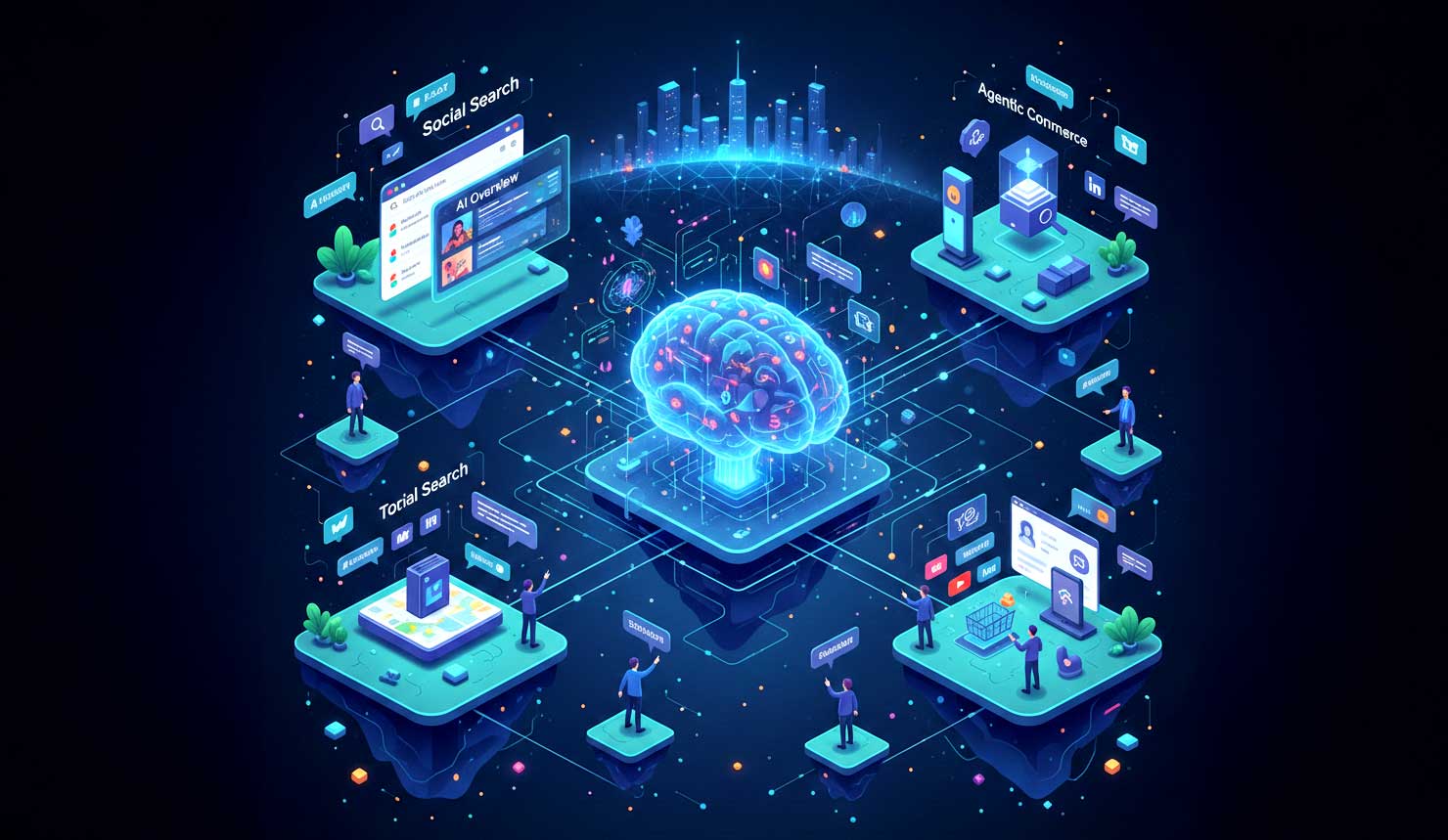
The world of Search Engine Optimization is not dying; it is maturing. The arrival of Generative AI, spearheaded by tools like Google’s AI Overviews and ChatGPT, has irrevocably reshaped the search landscape. As we look ahead to 2026, the era of relying solely on “10 blue links” is fading. Visibility now means being a recognized, trusted authority across a fragmented, AI-driven digital ecosystem.
To help you navigate this seismic shift, we’ve compiled the wisdom of leading SEO experts, condensing their 2026 predictions into the five most critical pillars for your strategy.
- Authority, Trust, and the Rise of E-E-A-T (Experience-Expertise-Authoritativeness-Trustworthiness)
If there is one signal that will dominate the 2026 search landscape, it is Brand Trust. Large Language Models (LLMs) and search engines are prioritizing content from sources they can confidently cite. Generic, AI-generated content (often referred to as ‘AI slop’) is flooding the internet, making authentic, human-led expertise the ultimate filter.
- Focus on the Human-First Mandate: Experts agree that Authenticity and Trust are the new ranking factors. Your content must demonstrate real-world experience and first-hand knowledge (the first ‘E’ in E-E-A-T). For informational content, this means going beyond regurgitation and including proprietary data, unique insights, and case studies that AI models cannot replicate.
- Brand Reputation as an Algorithmic Signal: Digital PR is rapidly replacing traditional link-building as a core SEO strategy. AI-driven search leans heavily on public sentiment and trusted sources. It’s no longer just about the link; it’s about the mention, the citation, and the positive perception of your brand across high-authority publications and forums like Reddit and LinkedIn. Expert Advice: Build your brand’s social proof by seeking out podcasts, getting featured in industry publications, and fostering positive third-party reviews.
- The Power of Branded Search: SEOs have historically focused on non-branded keywords. In 2026, the focus shifts. Growing branded search volume—people searching for “{your brand name} + {target keyword}”—is seen as a tide that lifts all other ranking efforts. It signals unshakeable trust and relevance to both AI and human users.
- From Keywords to Entities and Topical Depth
The mechanical process of matching keywords is an outdated SEO model. AI systems operate on semantic understanding and entity recognition—they see the full context of a topic, not just isolated phrases.
- Embrace Topical Authority: Forget keyword density. Success in 2026 requires building deep, comprehensive topic clusters that fully cover a subject. A single, in-depth pillar article should link to a network of related subtopics, establishing your brand as the definitive authority on a cluster of connected entities.
- Structure Content for AI Comprehension: AI answer engines and LLMs are the primary discovery layer for an increasing number of queries. To ensure your brand is cited (which matters more than being ranked in the traditional sense), your content needs to be easily digestible by machines. This means:
- Using structured data markup (Schema) consistently and correctly.
- Writing with clear, concise, and declarative language that is “citation ready.”
- Prioritizing content precision and clarity over jargon or overly creative messaging.
- Niche Content is the New Gold: As AI handles broad informational queries, the content that breaks through will be hyper-specific and tailored to the individual. Expert Advice: Map out clear audience personas and create content that speaks directly to their specific workflows, use cases, and industry edge cases, even if the traditional search volume seems low.
- Optimizing for “Search Everywhere” and Multichannel Visibility
Search is no longer confined to the traditional Google SERP. Users are bouncing between Google’s AI Overviews, TikTok, YouTube, Reddit, and specialized AI assistants before making a decision. This demands a “Search Everywhere Optimization” mindset.
- Optimize for AI Overviews (AIOs): With AIOs increasingly dominating the top of the SERP, the objective shifts from earning a click on a blue link to being the authoritative source cited within the AI-generated answer. Focus on providing direct, structured, and comprehensive answers.
- Go Multimodal and Multichannel: AI systems process more than just text. Your strategy must encompass video, audio, and visual content.
- Video Content: Produce short-form videos for TikTok and YouTube (which is itself a massive search engine) and embed them in your high-performing blog posts. Video builds trust and provides human-led experience that is harder for AI to replicate.
- Visual Search: With tools like Google Lens on the rise, optimizing images with high-quality originals and structured data will be essential for brand discovery.
- The Agentic Future: AI agents are beginning to complete transactional tasks on behalf of users (Agentic Commerce), such as ordering groceries or making purchases. Expert Advice: The focus must move beyond a simple click to optimizing for the final, automated conversion. Ensure your transactional content is clear, easily integrated, and conversion-focused.
- The Shift in Measurement: From Traffic to Visibility and Conversion Quality
In an era of zero-click searches and AI-generated summaries, overall organic traffic may decline, but the quality of user intent will rise. The users who do click through to your site will be much further along in their decision process.
- Visibility KPIs Over Traffic KPIs: Expert Advice: Your new metrics must track how often your brand is cited and mentioned across the AI layer of the search ecosystem. This includes monitoring your brand presence in AI Overviews, LLM answers, and third-party review sites. The question is: How often does your brand show up when people ask relevant questions online, even if they don’t click?
- Focus on Conversion Funnels: As AI answers informational queries, the focus of your on-site SEO shifts to the bottom-of-the-funnel. Informational content must act like a high-intent commercial landing page. The goal is to maximize the value of every high-intent visitor who reaches your site.
- Hyper-Local Micro-Dominance: For local businesses, the 2026 battleground isn’t winning an entire city—it’s achieving micro-market dominance in a specific district or neighborhood. Prioritizing a fully optimized Google Business Profile and actively collecting reviews are more critical than ever, as AI algorithms rely on consistent, authentic local data for verification.
- Using AI to Master the New SEO Landscape
AI is not just the challenge; it’s also the most powerful tool for adaptation. SEOs who embrace an “AI-Engineer SEO” mindset will gain a massive competitive advantage.
- AI for Smarter, Predictive SEO: AI tools will evolve beyond simple automation (like rank tracking) to enable predictive SEO. This means using AI to analyze user behavior, conversational patterns, and seasonality to anticipate what users will search for next and proactively create content to meet that future demand.
- Hybrid Content Strategies: The most successful brands in 2026 won’t be choosing between AI-generated content and human writers; they will be strategically combining the two. AI can handle the bulk of research, content outlining, and data synthesis, allowing human experts to layer in the unique insights, real-world experience, and proprietary data that satisfies the E-E-A-T mandate.
- Gaining Competitor Insights: AI tools are increasingly adept at uncovering competitor vulnerabilities, such as content gaps, unexploited backlink sources, and keywords where competitors are showing up in AI citations but your brand is not.
Conclusion
The SEO landscape of 2026 is an expansion, not a contraction. The 20 experts consistently point to one core truth: The internet is adopting a machine-shaped voice, and you must design your brand to be cited and trusted by that voice.
The winners will be the brands that build an unshakeable foundation of trust and authority, demonstrate genuine human experience, and optimize their content not just for one search engine, but for Search Everywhere. By prioritizing Authenticity, Agents, and Authority, you can future-proof your visibility and dominate the AI-first digital ecosystem.