The release of Gemini 3 this month wasn’t just another model update; it was a fundamental re-architecture of how Google Search processes human curiosity. For over two decades, Search was essentially a retrieval engine—matching keywords to an index. With the rollout of Gemini 3, Google has officially transitioned into a reasoning engine.
The most critical update for SEOs isn’t the model’s benchmark scores, but a specific backend mechanic confirmed by Google’s engineering teams: Automatic Model Selection with Intelligent Routing.
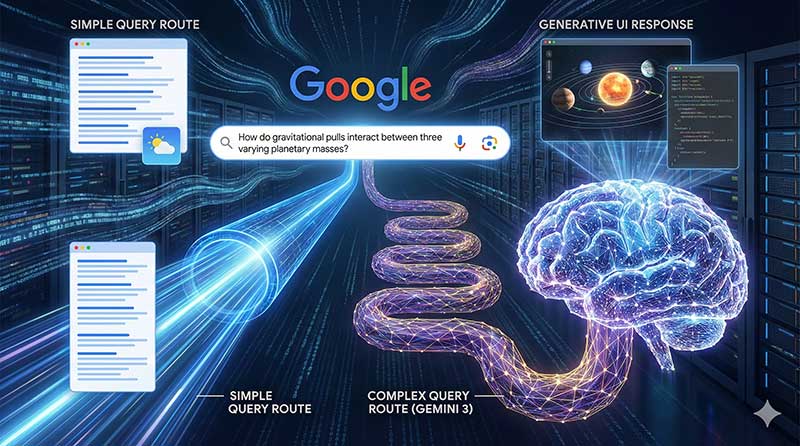
Google Search no longer treats every query the same. It now employs a sophisticated “air traffic control” system that distinguishes between simple informational lookups and complex, multi-step reasoning problems. The latter are now routed directly to Gemini 3, bypassing traditional retrieval logic in favor of agentic, generative problem-solving.
This article breaks down the technical mechanics of this routing, the introduction of “Generative UI,” and the specific strategies SEOs must adopt to survive in this split-stream search ecosystem.
The Mechanic: How “Intelligent Routing” Works
Understanding the why starts with understanding the how. According to documentation and engineering blogs released alongside Gemini 3, the search architecture now utilizes a Dynamic Retrieval Configuration.
When a user types a query, it passes through a lightweight “triage” model before it ever hits the index. This classifier assigns the query a complexity prediction score (often denoted as a float value between 0 and 1).
- Low-Complexity Scores (The Fast Lane): Queries like “weather in Fullerton” or “who won the Knicks game” are routed to Google’s standard, ultra-fast retrieval systems (likely lightweight versions of Gemini Flash or traditional rankers). The goal here is milliseconds-level latency.
- High-Complexity Scores (The Gemini 3 Lane): Queries that show high “reasoning density”—such as “compare the tax implications of an LLC vs. S-Corp for a freelance writer in California making $150k”—trigger the Gemini 3 route.
The Query Fan-Out
Once routed to Gemini 3, the process changes from “searching” to “researching.” Gemini 3 doesn’t just look for a matching page; it executes a Query Fan-Out. It breaks the user’s prompt into dozens of component sub-queries, executes them in parallel, reads the content, and synthesizes an answer.
For SEOs, this is terrifying and exciting. Your page might not rank for the “head term” the user typed, but if you answer one of the vital sub-questions Gemini 3 needs to solve the puzzle, your content is ingested and cited.
The Visual Shift: Generative UI and “Thinking” Mode
The most visible change in this new era is Generative UI. When a complex query is routed to Gemini 3, the search results page (SERP) is no longer a static list of blue links.
Gemini 3 now has the ability to code interactive interfaces on the fly.
- Example: If a user asks, “How do gravitational pulls interact between three varying planetary masses?”, Gemini 3 doesn’t just write a paragraph; it codes a JavaScript-based interactive simulation where the user can drag planets around.
- The SEO Implication: If your content is merely “text on a page,” you are competing against an interactive app generated in real-time. However, the data powering that simulation comes from somewhere. The new SEO gold rush is becoming the structured data source that Gemini trusts to build these visualizations.
Google has also introduced a “Thinking” toggle for AI Overviews, allowing users to see the reasoning steps Gemini is taking. This transparency offers SEOs a reverse-engineering map: if you can see the steps Gemini took to answer a question, you can create content that explicitly addresses those steps.
The Strategy: SEO for the Reasoning Engine
The “10 blue links” game is shrinking. The “Optimizing for Gemini 3” game is just beginning. Here is the strategic framework for 2026.
- Optimizing for “Reasoning Chains”
Old SEO was about Keywords. New SEO is about Logic Gaps.
Gemini 3 seeks to build a complete logical chain from question to answer. If the model encounters a gap in its reasoning (e.g., it knows how to install a heat pump but not the specific voltage requirements for a 2025 model), it performs a specific “fan-out” search to fill that gap.
Tactic: Don’t just write “Ultimate Guides.” Write “connector content” that bridges specific data points. Focus on the “Why” and “How” nuances that a general model might miss.
- Old Query Target: “Best CRM software”
- Gemini 3 Target: “How to migrate data from Salesforce to HubSpot without losing custom object mappings.”
- The Rise of “Data Feeds” over “Articles”
With Generative UI, Gemini 3 prefers raw, structured facts it can render itself. This elevates Schema Markup from a “nice-to-have” to “critical infrastructure.”
If you run a recipe site, Gemini doesn’t want your 500-word intro about your grandmother’s kitchen; it wants the JSON-LD data for ingredients, cooking time, and nutritional values so it can render a dynamic comparison table against other recipes.
Tactic: Audit your structured data. Ensure every claim, price, date, and specification on your site is wrapped in Schema. You are no longer writing for a human reader first; you are writing for a machine that is building a UI for a human.
- E-E-A-T as the “Routing Gatekeeper”
Why does Gemini 3 cite one source over another during a complex query fan-out? Trust.
Google needs to minimize “hallucinations” (errors). Therefore, the “Prediction Score” for routing also weighs the trustworthiness of the source domain. High-complexity queries (finance, health, law) act as a strict filter: if your site lacks E-E-A-T (Experience, Expertise, Authoritativeness, Trustworthiness) signals, Gemini 3 will not risk using your data in its synthesized answer.
Tactic: Double down on authorship. Verified expert bylines, citations of primary sources, and robust “About Us” pages are no longer vanity metrics—they are the API keys that grant you access to the Gemini 3 synthesis engine.
- Zero-Click vs. “High-Intent” Clicks
There is a valid fear that Gemini 3 answers everything, resulting in zero clicks to websites. However, early data suggests a “Qualifying Effect.”
Users who are satisfied by the AI summary were likely low-value traffic anyway (bounce-and-leave users). The users who do click through after reading a complex Gemini 3 breakdown are highly qualified. They have read the primer and are now looking for deep expertise or a transaction.
Tactic: Shift your conversion optimization (CRO) strategy. Assume the user arriving at your site is already educated. Remove the “101” fluff from your landing pages and get straight to the unique value proposition, advanced insights, or purchase capability.
The Future: Agentic Search is Here
We are witnessing the birth of Agentic Search. Gemini 3 isn’t just answering; it’s planning. Users can now say, “Plan a 3-day itinerary for Tokyo focusing on anime culture and book the restaurants.”
This means the future of SEO isn’t just about being found; it’s about being executable. Can the AI agent book your service? Can it extract your pricing? Can it navigate your availability calendar?
Conclusion: Adapt or Disappear
The routing of complex queries to Gemini 3 is a demarcation line in the history of search. On one side is the legacy web of keywords and links; on the other is the semantic web of entities, reasoning, and agents.
To succeed in this new environment, you must stop viewing your content as a destination and start viewing it as a knowledge library for Gemini. The goal is no longer just to rank #1; it is to be the indispensable fact that Gemini 3 must cite to solve the user’s problem.
The traffic might be lower in volume, but the intent has never been higher. Welcome to the era of the Reasoning Engine.