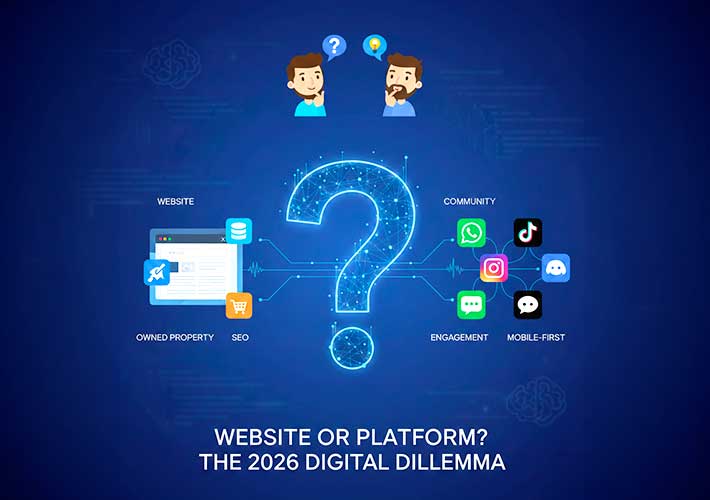
In a recent episode of the “Search Off the Record” podcast, Google’s Search Relations team, comprising Gary Illyes and Martin Splitt, tackled a question that has haunted the digital marketing industry for years: “Do you actually still need a website in 2026?”
For decades, a website was the non-negotiable “home base” for any brand. However, as AI-powered search, social commerce, and walled-garden platforms like WhatsApp and Instagram dominate user attention, the necessity of an independent site is being questioned by the very people who help build the world’s most powerful search engine.
The Core Debate: Web-First vs. Platform-Only
The conversation began by addressing the persistent “Web is Dead” claim. While Google Search is fundamentally built on crawling and indexing web content, the team’s stance was surprisingly pragmatic: A website is a business decision, not a mandatory requirement for success.
Gary Illyes noted that in certain markets and industries, businesses are already thriving without a traditional URL. He cited a Google study from Indonesia where small businesses ran entire operations through social media and messaging apps, achieving “incredible sales and user retention.”
When a Website Might Be Overkill
According to the Search Relations team, you might not need a website if:
- Your audience is platform-specific: If you manage a local community group that communicates exclusively via WhatsApp or Discord, a standalone site might be an unnecessary friction point.
- Trust is established elsewhere: Martin Splitt argued that a “nicely curated social media presence” often exudes more trustworthiness than a poorly maintained, outdated website.
- You are in a mobile-first niche: Certain mobile games and apps have become billion-dollar entities with nothing more than a simple legal landing page.
Why the “Web” Still Wins (Most of the Time)
Despite validating social-only models, the team highlighted that for the majority of businesses, the open web offers advantages that platforms cannot replicate.
- Ownership and Sovereignty
A website acts as your digital “owned” property. Unlike a social media profile, you aren’t subject to sudden algorithm shifts that can hide your content or platform-wide policy changes that could lead to account suspension.
- Lower Barriers to Entry
Illyes pointed out that the web is still the most accessible way to share information. Users don’t need to download an app, create an account, or commit storage space to access a website. This “lightweight” nature is critical for attracting first-time users or explaining new concepts.
- AI and the Data Layer
Perhaps the most crucial argument for the SEO community is that AI chatbots still depend on websites. Large Language Models (LLMs) and Google’s own AI Overviews draw their “knowledge” from published online material. Without websites to crawl, the information ecosystem for AI would eventually stagnate.
SEO in the Age of AI Search
The debate also touched on how discovery is shifting. As we move into 2026, the traditional “10 blue links” are being augmented by AI Mode and Agentic commerce.
- From Search to Assistance: Google is evolving from a search engine into a “helpful personal assistant.”
- The “Query Fan-Out” Technique: Google’s AI now breaks complex questions into sub-queries, researching multiple websites simultaneously to synthesize an answer.
- Zero-Click Reality: Roughly 27% of searches now result in no clicks, as users get their answers directly from the SERP.
Strategic Recommendations for 2026
If you are deciding whether to invest in a website this year, follow this framework based on the Search Relations team’s insights:
Use a Website if:
- You want broad, long-term visibility across multiple search engines and AI platforms.
- You need to host custom tools (calculators, interactive maps, or databases).
- You require full control over your brand’s presentation and data sovereignty.
Use Social/Apps if:
- Your primary goal is high-frequency engagement with a niche community.
- You are a local service provider in a region where messaging apps are the primary commerce tool.
- You lack the resources to maintain a high-quality, secure web presence.
Conclusion: The “It Depends” Era
The Google Search Relations team didn’t give a “one-size-fits-all” answer because the internet has become too fragmented for one. While websites remain the “source layer” for the global information economy, they are no longer the only path to a successful business.
The real task for marketers in 2026 is to define the goal before choosing the tool. If your goal is to be visible to the billions of queries processed by AI and search engines daily, your website isn’t just a luxury. It’s your most valuable asset.