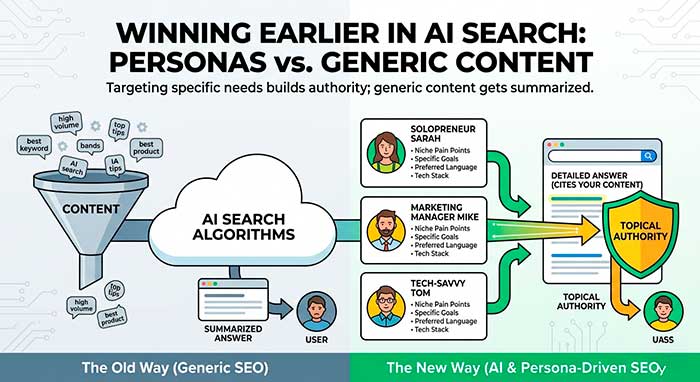
For the last decade, the SEO playbook was simple: find a high-volume keyword, write a “comprehensive” guide that touched on everything, and build enough backlinks to brute-force your way to Page 1.
But the game has changed. We have entered the era of AI-driven search. Between Google’s Search Generative Experience (SGE) and AI agents like Perplexity or ChatGPT, the “middle-of-the-road” content is dying. AI doesn’t just look for keywords; it looks for specificity, intent, and utility. If your content is generic, it’s invisible. To win earlier in the search journey, you need a level of depth that LLMs (Large Language Models) can recognize as uniquely valuable. That depth starts with Customer Personas.
The Problem: The “Generic Content Trap”
Most brands create content for an “average” user who doesn’t actually exist. They produce articles like “How to Improve Business Efficiency” or “Top Marketing Trends.” While these might have high search volume, they suffer from three fatal flaws in the AI search landscape:
- AI Can Summarize the Basics Better Than You: If your article is just a collection of common knowledge, an AI search engine will simply summarize those points in the search results. The user never clicks your link because the AI already gave them the “generic” answer.
- Lack of Semantic Depth: AI models look for “entities” and “relationships.” Generic content lacks the specific terminology and nuanced problem-solving that signals true expertise (E-E-A-T).
- The “Last Mile” Gap: AI search aims to solve a user’s problem instantly. If your content doesn’t address a specific persona’s unique pain point, the AI won’t recommend you as the “best” solution.
Why Customer Personas Change the Equation
A customer persona is no longer just a slide in a marketing deck; it is the architectural blueprint for your AI SEO strategy. Here is how they help you win:
- Uncovering “Hidden” Search Queries
Generic keyword research tools tell you what everyone is searching for. Personas tell you what your best customers are struggling with before they even know your product exists.
Instead of targeting “Project Management Software,” a persona-driven strategy targets “How to sync Jira tickets with client-facing dashboards for creative agencies.” The latter is highly specific, less competitive, and signals to AI that you are a niche authority.
- Meeting the “Intent” of the AI Agent
AI search engines are designed to be helpful assistants. When a user asks, “How do I scale my Shopify store without hiring more staff?”, the AI looks for content that understands the specific constraints of a solo entrepreneur.
By writing for a “Solopreneur Sarah” persona, your content naturally uses the language, tools, and constraints she cares about. The AI recognizes this alignment and prioritizes your content for that specific query.
- Building Topical Authority (The “Moat”)
AI models categorize websites by their Topical Authority. If you write generic content, the AI sees you as a generalist. If you write deeply researched content across the entire journey of a specific persona, the AI sees you as an expert.
How to Build “AI-Ready” Personas
To win in AI search, your personas need to go deeper than “Age: 30-45” and “Interests: Golf.” You need to map the Information Journey.
| Persona Element | Traditional SEO Focus | AI Search Focus |
| Pain Points | High-level problems. | Specific “Edge Case” frustrations. |
| Language | Search volume keywords. | Natural Language & Industry Jargon. |
| Tech Stack | N/A | How your solution integrates with their specific tools. |
| Trust Signals | Backlinks. | First-person experience and case studies. |
Step 1: Identify the “Zero-Click” Resistance
Ask: “What part of this persona’s problem can an AI not answer with a simple summary?” Usually, this is personal experience, proprietary data, or complex workflow integration. That is where your content starts.
Step 2: Map the Semantic Map
Don’t just list keywords. List the entities your persona interacts with. If your persona is a “DevOps Engineer,” your content should naturally mention Kubernetes, CI/CD pipelines, latency issues, and YAML files. This “semantic density” tells the AI you are writing for a pro.
Implementing Persona-Driven Content: A Practical Guide
Once you have your personas, you need to shift your content production. Here is how to show up earlier in the search journey:
- Target the “Pre-Problem” Stage
Before someone searches for a solution, they search for the symptoms of their problem.
- Generic: “Best Accounting Software.”
- Persona-Driven: “Why does my cash flow statement never match my bank balance in QuickBooks?”
The second query is where you “win earlier.” You capture the user when they are frustrated, and you provide the solution before they even start shopping.
- Use the “Problem-Agitation-Solution” (PAS) Framework
AI search engines prioritize content that follows a logical, helpful flow.
- Identify the persona’s problem clearly in the H1/H2.
- Agitate the problem by showing you understand their specific nuance (e.g., “We know this is especially hard for teams using remote-first workflows”).
- Provide a unique solution that isn’t just a restatement of the obvious.
- Optimize for “Natural Language” Questions
People talk to AI search engines like they talk to people. Use your persona research to brainstorm the exact questions they ask. Use these as your H2 headings.
- Example: “How can a mid-sized law firm automate intake without losing the personal touch?”
The Result: Winning the AI “Citation”
When an AI like Google SGE or Perplexity generates an answer, it provides citations. It doesn’t cite the most “generic” source; it cites the source that provides the most relevant evidence for the user’s specific context.
By using customer personas, you stop writing for the algorithm and start writing for the human. Paradoxically, this is exactly what the modern AI algorithm wants. You become the “source of truth” for a specific type of person, making you the primary citation in the AI’s response.
Summary: Your AI SEO Checklist
- Ditch the “Ultimate Guide” to everything; create the “Specific Guide” for one persona.
- Focus on Long-Tail Intent: Solve the niche problems that AI summaries miss.
- Speak the Language: Use the specific terminology and “entity” references your persona uses.
- Show, Don’t Just Tell: Use data, screenshots, and first-person accounts to prove expertise.